
 Hover to zoom
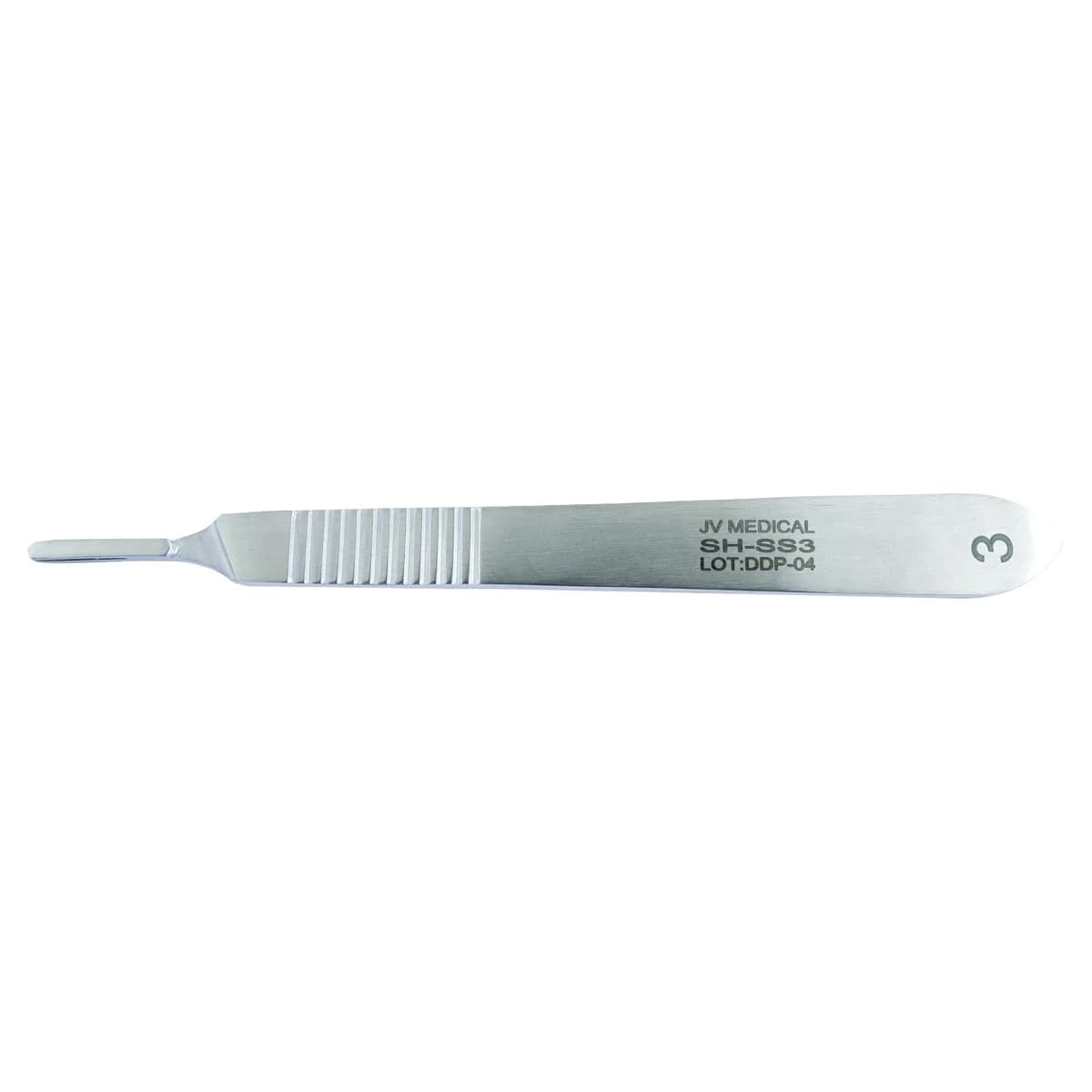
Scalpel Handle No. 3
Scalpel Handle No. 3 in surgical stainless steel — secure blade fitting, fully autoclavable, compatible with standard surgical blades.
Add $141.01 more to your order for free WA shipping — otherwise flat $15 across serviced WA areas.
- Secure eWAY payment
- 48-hour dispatch
- 30-day returns*
Overview
The Scalpel Handle is machined from a single piece of surgical stainless steel with a precisely milled blade fitting that holds standard surgical blades rigidly and releases them safely. Graduated markings and a balanced weight give excellent control for incisions and debridement.
Widely known as a BP handle No. 3 (after the original Bard-Parker pattern), the No. 3 is the small-blade workhorse of the scalpel handle family. Its milled fitting accepts the standard small blade series — including sizes 10, 10a, 11, 12 and 15 — which covers everything from fine stab incisions with an 11 blade to the curved 10 and 15 blades used for skin incisions, sharp debridement and lesion work. If your procedures use blades in that series, this is the handle they mount to.
The flat, graduated handle profile gives a stable pencil or fingertip grip for controlled, shallow work, and the one-piece surgical stainless steel construction has no seams to trap soil during reprocessing. It is TGA-registered and produced by an ISO 13485-certified manufacturer, and because it is fully autoclavable it can be reprocessed indefinitely — one reusable handle replaces a stream of disposable scalpels at a fraction of the ongoing cost.
GP procedure rooms, podiatry clinics, dermatology practices, veterinary surgeries and training laboratories across Western Australia all run on this same No. 3 fitting, so blades are always easy to source.
Also known as: BP Handle No. 3, Bard-Parker handle #3, Surgical blade handle No. 3, No. 3 knife handle, Scalpel blade holder (No. 3 fitting).
Care & sterilisation
Remove blades safely before reprocessing. Clean, dry and autoclave between patients per your practice protocol.
Clinical applications
GP procedure rooms · Podiatry clinics · Dermatology and skin cancer clinics · Hospitals and day surgeries · Veterinary practices · University and training laboratories
Common procedures
Used wherever the small blade series operates: skin incisions and excisions with 10 and 15 blades, stab incisions and precise point work with an 11 blade, and curved 12-blade work in confined sites. In podiatry it is the standard handle for sharp debridement of callus and corn enucleation with a 15 or 10a blade.
Recommended users
General practitioners · Podiatrists · Dermatologists and skin cancer doctors · Surgeons and registrars · Veterinarians · Practice nurses · Medical and podiatry students
Buying guide
Match the handle number to the blade series you use: this No. 3 takes the small blades (10, 10a, 11, 12, 15) that dominate GP minor surgery, podiatry debridement and dermatological work, whereas a No. 4 handle takes the larger 20-series blades used for bigger incisions. If your clinic already stocks 10/11/15 blades, the No. 3 is the correct — and only — choice. Given the low price, most practices buy several: one per treatment room plus spares for kits, so a handle is never held up in the steriliser.
Care & maintenance
- Cleaning: Remove and discard the blade into a sharps container before any cleaning. Brush the blade seat and graduations with a neutral-pH detergent, as the milled fitting is where soil accumulates.
- Sterilisation: Autoclave bladeless on your standard validated steam cycle, pouched where sterility must be maintained; the one-piece handle has no lumens or joints requiring special processing.
- Maintenance: Inspect the blade seat for burrs or deformation whenever you mount a blade — a blade that rocks or seats loosely means the handle should be withdrawn. Otherwise the handle needs no routine maintenance beyond standard reprocessing.
- Storage: Store dry with your general instrument stock; keep a designated blade remover or forceps nearby so blades are never removed by hand at the point of storage.
- One-piece surgical stainless steel construction
- Secure, standard-fitting blade mount
- Balanced weight for precise control
- Fully autoclavable
- No. 3 fitting accepts standard small blades — sizes 10, 10a, 11, 12 and 15
- Interchangeable with any BP handle No. 3 pattern, so existing blade stock still fits
- Flat graduated profile supports precise pencil and fingertip grips
- Seam-free one-piece construction leaves nowhere for soil to lodge during reprocessing
- TGA-registered, made by an ISO 13485-certified manufacturer
- Reusable economy — one autoclavable handle replaces ongoing disposable scalpel spend
- Standard No. 3 fitting — blades 10, 10a, 11, 12 and 15 from any major maker mount securely
- One-piece stainless steel — nothing to loosen, and reprocessing reaches every surface
- Balanced flat profile — the control of a precision grip for shallow, accurate cutting
- Autoclavable and reusable — dramatically cheaper per procedure than disposable scalpels
- Low unit price — outfit every room and kit with an identical handle for $8.99 GST inc
Full details: Shipping policy · Returns policy
Frequently asked questions
Which scalpel blades fit a No. 3 handle?
The standard small blade series: sizes 10, 10a, 11, 12 and 15 (including common variants such as 15c). Any standard surgical blade in that series from a mainstream manufacturer will seat on the No. 3 fitting.
Is this the same instrument as a BP handle No. 3?
Yes. BP stands for Bard-Parker, the original maker whose pattern became the universal standard, so 'BP handle No. 3', 'scalpel handle No. 3' and 'No. 3 knife handle' all describe this same instrument and fitting.
How does a No. 3 handle differ from a No. 4?
The blade fitting size. A No. 3 takes the small blade series (10, 10a, 11, 12, 15) used for fine and minor procedures, while a No. 4 takes the larger 20-series blades (20-24) for bigger incisions. Blades are not interchangeable between the two fittings.
What is the safest way to fit and remove blades?
Never use fingers. Grip the blade's blunt spine with needle-nose forceps or a needle holder, slide it onto the fitting until it clicks over the lug, and reverse the motion to remove — or use a purpose-made blade remover. Discard used blades directly into a sharps container.
Can I autoclave the handle with a blade still attached?
No. Remove and discard the blade into a sharps container before reprocessing — blades are single-use, and a mounted blade prevents proper cleaning of the fitting and creates a sharps hazard for reprocessing staff. Autoclave the bare handle only.
What are the graduated markings on the handle for?
The graduations along the handle provide a convenient in-field reference scale, useful for quickly gauging the size of a lesion or wound during a procedure without reaching for a separate ruler.
Which procedures commonly use a No. 3 scalpel handle?
Skin incisions and excisions in GP minor surgery, shave and elliptical excisions in dermatology, sharp debridement of callus and corns in podiatry, suture removal with an 11 blade, and general dissection work in veterinary and teaching settings.
How long will a stainless steel scalpel handle last?
With routine care there is no set replacement interval — the one-piece surgical stainless steel body has no moving parts to wear. Replace it only if the blade seat becomes burred or damaged so that blades no longer mount firmly.
Specifications
| Material | Stainless Steel |
|---|---|
| Size | No. 3 |
| SKU | SH-SS3 |
| Grade | Surgical grade |
| Reusable | Yes |
| Sterilisation | Autoclavable |
| Blade compatibility | Standard surgical blades (No. 3 fitting) |