
 Hover to zoom
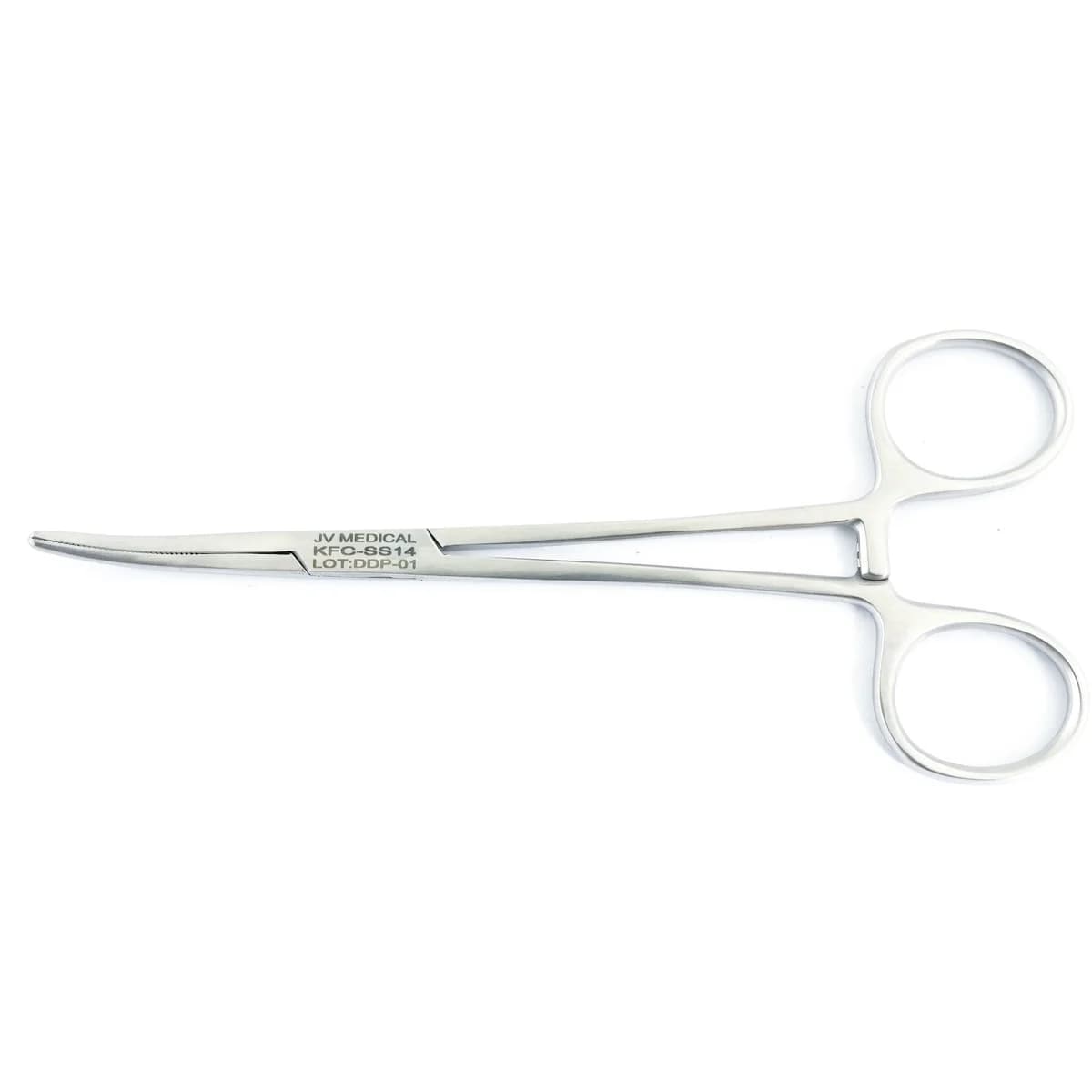
Kelly Artery Forceps — Curved 14cm
Kelly Artery Forceps — Curved, 14cm in Stainless Steel — precise tip alignment and reliable grip for clinical and surgical use. Autoclavable.
Add $135.01 more to your order for free WA shipping — otherwise flat $15 across serviced WA areas.
- Secure eWAY payment
- 48-hour dispatch
- 30-day returns*
Overview
The Kelly Artery Forceps — Curved (14cm) is precision-machined from surgical-grade stainless steel with carefully aligned tips for a secure, predictable grip. Whether grasping tissue, holding swabs or achieving haemostasis, the instrument delivers consistent spring tension and tactile control.
The Kelly artery forceps — widely known in Australian theatres simply as a haemostat or artery clamp — is a ring-handled, ratcheted instrument designed to occlude blood vessels and hold tissue securely without continuous hand pressure. This curved 14cm pattern angles the jaws away from the line of sight, improving visibility around the clamp point and letting the operator work at awkward angles during dissection and haemostasis. It is one of the most versatile clamps a practice can own, moving comfortably between vessel control, blunt dissection and general utility duties on the tray.
The Kelly pattern carries transverse serrations along the working portion of the jaws, giving dependable purchase on vessels, tissue pedicles and drapes alike. Machined from surgical-grade stainless steel by an ISO 13485-certified manufacturer and TGA-registered for the Australian market, the instrument features a three-position ratchet that locks positively at graduated pressures and releases cleanly with a familiar thumb-and-finger action.
JV Medical stocks this curved Kelly alongside the rest of our forceps range at our Perth warehouse for rapid supply to WA practices. Need matching instruments for a minor-ops or dressing tray?
Also known as: Kelly haemostat, Curved artery clamp, Kelly haemostatic forceps, Curved haemostat 14cm.
Care & sterilisation
Clean promptly after use, paying attention to serrations and box joints. Sterilise in an open position and inspect tip alignment regularly to maintain performance.
Clinical applications
Hospitals · Day surgeries · GP procedure rooms · Emergency departments · Veterinary surgeries · Podiatric surgery · Training laboratories
Common procedures
Curved Kelly forceps are used to clamp bleeding vessels and achieve haemostasis during excisions, minor surgery and general surgical procedures. They also serve for blunt dissection, holding tissue pedicles, securing drapes and grasping or clamping tubing where a locked hold is needed.
Recommended users
Surgeons · General practitioners performing minor surgery · Emergency doctors · Theatre nurses · Veterinarians · Podiatric surgeons
Buying guide
Choose curved Kelly forceps when visibility around the clamp matters — the curve lifts your hand out of the line of sight and follows tissue planes naturally during blunt dissection. A straight pattern suits surface-level clamping and utility work. At 14cm the Kelly sits between the finer mosquito haemostat (better for very small vessels) and longer patterns used in deeper fields, making it the most versatile single haemostat for a minor surgery setup. Most trays carry curved and straight haemostats in pairs, so consider ordering multiples for uninterrupted turnaround between sterilisation cycles.
Care & maintenance
- Cleaning: Open the ratchet fully and clean the box joint, ratchet teeth and jaw serrations promptly after use; an ultrasonic cycle followed by thorough rinsing is ideal for the joint mechanism.
- Sterilisation: Autoclave in the fully open, unratcheted position so steam reaches the box joint; closed-and-locked instruments risk incomplete sterilisation and joint stress.
- Maintenance: Apply a surgical-grade instrument lubricant to the box joint after cleaning, and check that each ratchet position engages and releases crisply. Retire the instrument if the ratchet slips under closing pressure.
- Storage: Store unlocked, or closed on the first ratchet tooth only, in a dry tray — long-term storage under full ratchet tension fatigues the joint and jaws.
- Surgical-grade stainless steel with corrosion-resistant finish
- Precisely aligned serrated or toothed tips
- Consistent spring tension for fatigue-free handling
- Fully autoclavable for repeated sterilisation
- Trusted patterns used across general practice, nursing and theatre settings
- Curved jaws improve visibility and access around the clamp site
- Three-position ratchet lock holds vessels without sustained hand pressure
- Transverse jaw serrations give secure purchase on vessels and pedicles
- TGA-registered haemostat pattern from an ISO 13485-certified manufacturer
- Ring handles suit both palmed and three-point grips
- 14cm length balances reach with fine control in superficial fields
- Ratchet lock — maintains vessel occlusion hands-free while you work
- Curved profile — keeps your hand and the instrument body out of the visual field
- Serrated jaws — reliable grip that resists tissue and vessel slippage
- Autoclavable stainless steel — long service life under repeated reprocessing
- Versatile pattern — one instrument covers clamping, dissection and utility roles
Full details: Shipping policy · Returns policy
Frequently asked questions
What is the difference between Kelly and mosquito artery forceps?
Both are ratcheted haemostats, but mosquito (Halsted) forceps are smaller and finer, suited to very small vessels, while the Kelly is a mid-size pattern with more jaw and shank strength for general clamping duties.
Why choose curved artery forceps instead of straight?
The curve keeps your hand and the instrument shanks out of your line of sight and follows natural tissue planes during blunt dissection. Straight patterns are preferred for surface clamping and utility tasks.
What exactly is a haemostat?
A haemostat is a ratcheted, ring-handled forceps used to clamp blood vessels and stop bleeding. Artery forceps, haemostatic forceps and artery clamps are all names for the same family — the Kelly is one of its classic patterns.
Can Kelly forceps be used to clamp tubing or hold drapes?
Yes — alongside haemostasis they are commonly used as utility clamps for tubing, drains and drapes. Many clinics keep dedicated pairs for non-tissue tasks so the tissue instruments stay in top condition.
How does the ratchet mechanism work and how should I look after it?
Interlocking ratchet teeth between the ring handles lock the jaws at graduated pressures until released with a slight counter-squeeze. Keep the teeth clean, lubricate the box joint after each reprocessing cycle, and never store the instrument fully clamped.
How do Kelly forceps compare with Spencer Wells artery forceps?
Both are mid-size ratcheted haemostats used interchangeably in many Australian settings. Jaw serration detail and profile differ slightly between the patterns, but for general clamping either performs the same clinical role.
Should artery forceps be autoclaved open or closed?
Always open and unratcheted. Sterilising a locked instrument blocks steam from the box joint and ratchet faces and places sustained stress on the jaws.
Can I order several pairs at practice or trainee kit quantities?
Yes — at $14.99 including GST the Kelly is well suited to multi-pair orders for suture kits and training sets. Orders over $150 ship free across serviced WA areas, and everything dispatches within 48 hours.
Specifications
| Material | Stainless Steel |
|---|---|
| Size | 14cm |
| SKU | KFC-SS14 |
| Grade | Surgical grade |
| Reusable | Yes |
| Sterilisation | Autoclavable |